
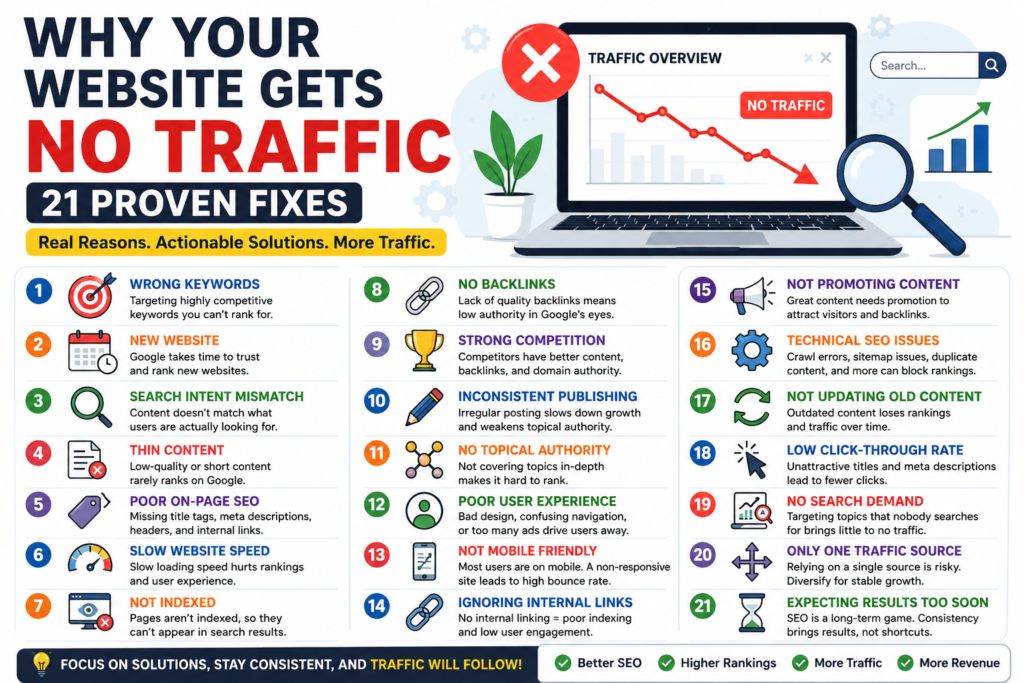
If you’re wondering why your website gets no traffic, you’re not alone. Many website owners struggle to attract visitors despite publishing content regularly.
Launching a website is exciting. You spend hours creating content, designing pages, and optimizing everything. Then you check your analytics and discover a frustrating reality: almost nobody is visiting your website.
If this sounds familiar, you’re not alone.
Many website owners believe traffic will automatically arrive once a site goes live. Unfortunately, that’s not how search engines work. Millions of websites compete for attention every day, and without the right strategy, your content can remain invisible.
The good news is that most traffic problems have clear solutions.
Whether you’re a blogger, affiliate marketer, business owner, or content creator, understanding why your website gets no traffic is the first step toward fixing the problem.
In this guide, you’ll discover 21 proven reasons websites struggle to attract visitors and practical solutions you can implement today.
If you’re struggling with low traffic, you may also want to read our guide on website traffic issues where we cover additional reasons websites fail to attract visitors and practical solutions to fix them
Quick Overview: Why Websites Fail to Get Traffic
| Problem | Impact |
|---|---|
| Poor keyword targeting | Low rankings |
| Thin content | Reduced visibility |
| Slow website speed | Higher bounce rates |
| No backlinks | Weak authority |
| Poor SEO optimization | Limited organic traffic |
| Lack of consistency | Slow growth |
| Technical SEO issues | Indexing problems |
Let’s explore each issue in detail.
1. You’re Targeting the Wrong Keywords
One of the biggest reasons websites receive no traffic is targeting keywords that are too competitive.
For example, trying to rank for:
- “SEO”
- “Blogging”
- “Make Money Online”
is extremely difficult for new websites.
Instead, focus on long-tail keywords such as:
- Best SEO tools for beginner bloggers
- How to start a travel blog in 2026
- Low competition keywords for affiliate marketing
How to Fix It
Use keyword research tools to find:
- Low competition keywords
- Long-tail phrases
- Questions users actually search for
The easier the keyword, the faster you can rank.
2. Your Website Is Too New
Google doesn’t instantly trust new websites.
Most websites experience what’s commonly called the “Google Sandbox” effect, where rankings take time to develop.
What You Should Do
Instead of expecting immediate traffic:
- Publish content consistently
- Build authority
- Gain backlinks
- Improve user experience
Patience is essential during the first few months.
3. Your Content Doesn’t Match Search Intent
Search intent is one of Google’s most important ranking factors.
Imagine someone searches:
“Best laptops for students”
But your article discusses laptop history.
Google quickly notices users aren’t getting what they want and lowers your rankings.
Types of Search Intent
- Informational
- Navigational
- Commercial
- Transactional
Always create content that directly satisfies the searcher’s goal.
4. Your Content Is Too Thin
Publishing short, low-value articles rarely works anymore.
Google rewards content that solves problems completely.
Signs of Thin Content
- Less than 500 words
- No examples
- No statistics
- No practical advice
- Outdated information
Better Approach
Create comprehensive content that:
- Answers related questions
- Includes examples
- Offers actionable tips
- Covers the topic thoroughly
Quality almost always beats quantity.
5. You Haven’t Optimized On-Page SEO
Even excellent content can struggle without proper optimization.
Essential On-Page SEO Elements
Title Tag
Include your primary keyword naturally.
Example:
Why Your Website Gets No Traffic (21 Proven Fixes)
Meta Description
Write a compelling summary that encourages clicks.
Headers
Use:
- H1
- H2
- H3
to structure content clearly.
Internal Links
Link to relevant articles on your website.
This improves:
- User experience
- Crawlability
- Topical authority
6. Your Website Loads Too Slowly
Speed matters.
Research consistently shows that users leave websites that take too long to load.
Common causes include:
- Large images
- Poor hosting
- Too many plugins
- Unoptimized code
How to Improve Website Speed
- Compress images
- Use caching
- Choose reliable hosting
- Remove unnecessary plugins
- Enable CDN services
A faster website often leads to better rankings and more traffic.
7. Google Hasn’t Indexed Your Pages
If Google hasn’t indexed your content, it cannot rank.
How to Check Indexing
Search:
site:yourdomain.com
If pages don’t appear, indexing may be the problem.
Fixes
- Submit your sitemap
- Use Google Search Console
- Request indexing manually
- Fix crawl errors
- Improve internal linking
Getting indexed is the foundation of organic traffic.
8. You Don’t Have Enough Backlinks
Backlinks remain one of Google’s strongest ranking signals.
Think of backlinks as votes of confidence from other websites.
A website with zero backlinks often struggles to compete against established competitors.
How to Build Backlinks
- Guest posting
- Resource page outreach
- HARO alternatives
- Original research
- Linkable assets
- Statistics articles
Focus on quality rather than quantity.
9. Your Content Isn’t Better Than Competitors
Google compares your content against existing search results.
Ask yourself:
Why should Google rank your article instead of the current top results?
Improve Content By Adding
- Personal experience
- Screenshots
- Case studies
- Original data
- Better formatting
- Updated information
The goal is not to create more content.
The goal is to create better content.
Many bloggers now use AI tools to speed up content creation. However, publishing AI-generated content alone isn’t enough. Understanding can AI tools help websites rank higher can help you create content that provides genuine value and stands out from competitors
10. You’re Not Publishing Content Consistently
Many website owners publish a few articles and then disappear for weeks or months.
Unfortunately, SEO rewards consistency.
When Google sees a website regularly publishing helpful content, it signals that the site is active and valuable to users.
Why Consistency Matters
Consistent publishing helps:
- Increase keyword coverage
- Build topical authority
- Improve crawl frequency
- Attract repeat visitors
Practical Tip
Create a content calendar and stick to it.
For example:
| Frequency | Articles Per Month |
|---|---|
| 1 per week | 4 |
| 2 per week | 8 |
| 3 per week | 12 |
Even one high-quality article per week can generate significant results over time.
Creating content regularly can be challenging. Using proven ChatGPT prompts for faster blog rankings can help streamline your workflow and maintain a consistent publishing schedule.
11. Your Website Lacks Topical Authority
Google prefers websites that cover a subject comprehensively.
For example, if your site is about blogging, publishing only one article on SEO isn’t enough.
Instead, create multiple related articles covering:
- Keyword research
- On-page SEO
- Technical SEO
- Link building
- Content marketing
- Search Console
This creates a content cluster that strengthens your expertise.
Example
Instead of writing:
- One article about blogging
Write:
- How to Start a Blog
- Best Blogging Tools
- SEO for Bloggers
- Content Writing Tips
- Affiliate Marketing for Bloggers
This approach builds topical authority and improves rankings.
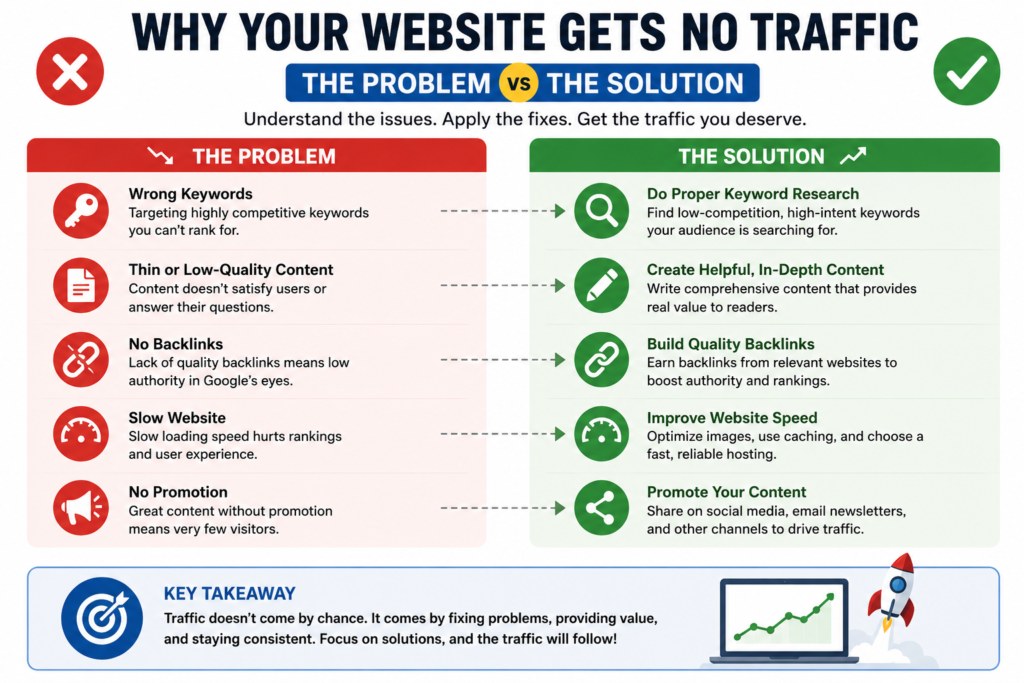
12. Your Website Has Poor User Experience
Google pays close attention to user behavior.
If visitors leave your website immediately, it may signal poor user experience.
Common UX Problems
- Difficult navigation
- Too many ads
- Cluttered design
- Hard-to-read text
- Intrusive popups
How to Improve User Experience
- Use larger fonts
- Add whitespace
- Simplify navigation
- Make pages mobile-friendly
- Reduce distractions
A clean and simple website often performs better than a complicated one.
13. Your Site Isn’t Mobile Friendly
Most internet users now browse websites from smartphones.
If your website looks broken on mobile devices, visitors will leave quickly.
Signs of Poor Mobile Optimization
- Tiny text
- Buttons too close together
- Horizontal scrolling
- Slow loading pages
Mobile Optimization Checklist
✔ Responsive design
✔ Fast loading speed
✔ Readable fonts
✔ Mobile-friendly menus
✔ Optimized images
A mobile-friendly website is no longer optional—it’s essential.
14. You’re Ignoring Internal Linking
Internal links help search engines understand your website structure.
They also guide users toward related content.
Benefits of Internal Linking
- Better indexing
- Improved user engagement
- Higher page authority distribution
- Increased page views
Example
If you publish an article about keyword research, link to related posts such as:
- On-page SEO guide
- Blogging tips
- Content writing strategies
The stronger your internal linking structure, the easier it becomes for Google to discover your content.
15. You’re Not Promoting Your Content
Publishing content is only half the job.
Promotion is equally important.
Many website owners hit “Publish” and expect traffic to appear automatically.
That’s rarely how it works.
Content Promotion Ideas
- Pinterest marketing
- Email newsletters
- Facebook groups
- LinkedIn posts
- X (Twitter)
- Reddit communities
- Quora answers
The more exposure your content receives, the greater the chance of earning backlinks and traffic.
Quick Rule
Spend as much time promoting content as creating it.
16. Your Website Has Technical SEO Problems
Technical SEO issues can prevent your pages from ranking properly.
Sometimes the problem isn’t your content—it’s your website’s technical setup.
Common Technical SEO Issues
Broken Links
Broken pages create a poor user experience and waste crawl budget.
Missing Sitemap
Without a sitemap, search engines may struggle to discover pages.
Duplicate Content
Duplicate pages can confuse Google about which version to rank.
Incorrect Robots.txt Settings
Blocking important pages can stop them from appearing in search results.
Technical SEO Checklist
- Fix broken links
- Submit XML sitemap
- Remove duplicate pages
- Improve site structure
- Check crawl errors regularly
- Monitor Search Console reports
Even small technical improvements can have a major impact on traffic growth.
17. You’re Not Updating Old Content
Many website owners focus only on publishing new articles and forget about existing content.
However, Google prefers fresh, updated information—especially for topics that change frequently.
Why Content Updates Matter
Updating old content can:
- Improve rankings
- Increase click-through rates
- Fix outdated information
- Add new keywords
- Improve user experience
What to Update
- Statistics and data
- Screenshots
- Examples
- Internal links
- SEO titles
- Meta descriptions
Even a small refresh can bring an article back to the first page of Google.
18. Your Click-Through Rate (CTR) Is Too Low
Sometimes pages rank on Google but still receive little traffic.
The reason is often a low click-through rate.
If people don’t click your result, rankings alone won’t generate visitors.
How to Improve CTR
Write Better Titles
Instead of:
SEO Tips
Use:
21 SEO Tips That Increased My Traffic by 300%
Use Numbers
Titles with numbers often attract more clicks.
Examples:
- 11 Proven Strategies
- 25 Blogging Mistakes
- 7 Easy Fixes
Create Curiosity
Give users a reason to click while remaining accurate.
A higher CTR can lead to more traffic without improving rankings.
19. You’re Targeting Topics With No Search Demand
Sometimes the issue isn’t SEO.
It’s the topic itself.
You might create excellent content, but if nobody searches for it, traffic will remain low.
How to Validate a Topic
Before writing:
- Check search volume
- Analyze competitors
- Look for related searches
- Study Google autocomplete
- Explore question-based keywords
Example
A highly detailed article on an obscure subject may get almost no searches.
A practical article answering a common problem can attract traffic for years.
Always validate demand before investing time in content creation.
20. You’re Depending on One Traffic Source
Relying only on Google is risky.
Algorithm updates can dramatically affect traffic overnight.
Successful websites diversify their traffic sources.
Traffic Sources Worth Building
Organic Search
Google, Bing, and other search engines.
Excellent for blogging, lifestyle, recipes, and DIY niches.
Email Marketing
One of the most reliable long-term traffic sources.
Social Media
Platforms like LinkedIn, X, Facebook, and Instagram can drive targeted visitors.
Referral Traffic
Traffic from backlinks, partnerships, and mentions on other websites.
Diversification creates a more stable and sustainable traffic strategy.
21. You’re Expecting Results Too Quickly
Perhaps the most common reason website owners fail is unrealistic expectations.
SEO is not an overnight strategy.
Many successful websites spent months creating content before seeing significant traffic growth.
What Realistic SEO Growth Looks Like
| Time Period | Typical Result |
|---|---|
| 1–3 Months | Foundation building |
| 3–6 Months | Initial rankings |
| 6–12 Months | Noticeable traffic growth |
| 12+ Months | Strong authority and momentum |
The websites that succeed are usually the ones that continue publishing, improving, and learning long after others quit.
Key Takeaway
Consistency beats perfection.
Small improvements made every week can compound into substantial traffic growth over time.
Case Study: From Zero Traffic to Consistent Growth
Consider a new blog that publishes one article every month.
After six months, it has only six articles and very little traffic.
Now compare that with a blog that:
- Publishes two articles per week
- Targets low-competition keywords
- Builds internal links
- Updates old content
- Improves page speed
After six months, that website could have more than 50 high-quality pages attracting traffic from dozens of keywords.
The difference isn’t luck.
It’s strategy and consistency.
Quick Action Plan to Increase Website Traffic
If your website gets no traffic today, start with these steps:
Week 1
- Audit existing content
- Check indexing status
- Fix technical SEO issues
Week 2
- Research low-competition keywords
- Create a content plan
- Optimize old articles
Week 3
- Improve internal linking
- Enhance page speed
- Improve mobile usability
Week 4
- Promote content
- Build backlinks
- Track rankings and traffic
Repeat this process every month for long-term growth.
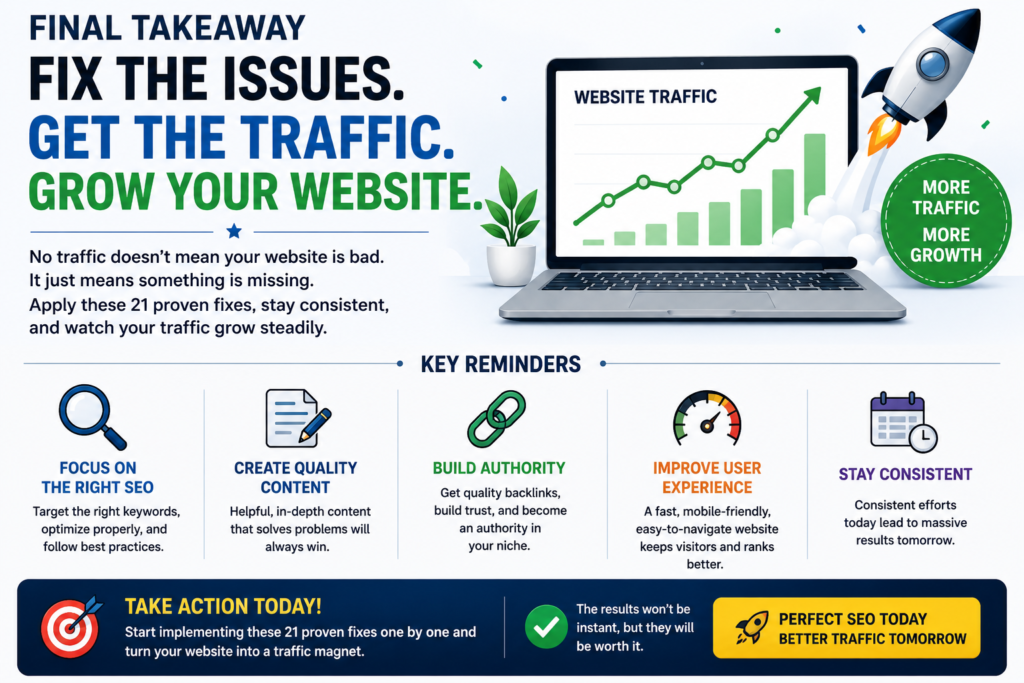
Conclusion
Getting little or no website traffic can be frustrating, but it doesn’t mean your website is doomed to fail.
If you’re serious about growing your website, it’s worth learning the latest SEO strategies that drive traffic in 2026. Staying updated with modern SEO practices can help you achieve faster and more sustainable growth
In most cases, traffic problems are caused by a combination of issues such as poor keyword targeting, weak content, technical SEO mistakes, lack of backlinks, or inconsistent publishing.
The encouraging news is that every one of these problems can be fixed.
Focus on creating genuinely helpful content, targeting keywords people actually search for, improving your website experience, and building authority over time.
Remember that SEO is a long-term investment.
The websites that consistently publish valuable content, update old articles, and prioritize user experience are the ones that eventually dominate search results.
Instead of looking for shortcuts, focus on steady improvements.
One optimized article, one quality backlink, and one content update at a time can transform a website with zero traffic into a thriving online asset.
For a deeper understanding of modern SEO best practices, Google’s official Google SEO Starter Guide is an excellent resource for website owners and bloggers looking to improve their search visibility.
Frequently Asked Questions (FAQs)
Why is my website getting no traffic?
The most common reasons include poor keyword targeting, lack of backlinks, thin content, indexing issues, and weak SEO optimization.
How long does it take for a new website to get traffic?
Most websites begin seeing meaningful organic traffic within 3 to 12 months, depending on competition, content quality, and SEO efforts.
Can a website rank without backlinks?
Yes, especially for low-competition keywords. However, backlinks significantly improve authority and ranking potential.
How many blog posts do I need before getting traffic?
There is no fixed number, but websites with 30–50 high-quality articles generally have a better chance of attracting consistent traffic.
Does website speed affect SEO?
Yes. Slow websites can increase bounce rates and negatively impact user experience, which may hurt rankings.
How often should I publish content?
Consistency matters more than frequency. Publishing one high-quality article per week is often more effective than publishing many low-quality posts.
Why are my pages not showing on Google?
Your pages may not be indexed, could have technical SEO issues, or may be targeting keywords that are too competitive.
Should I update old blog posts?
Absolutely. Updating old content can improve rankings, increase traffic, and keep information relevant for readers.
Is SEO still worth it in 2026?
Yes. SEO remains one of the most sustainable and cost-effective ways to generate long-term website traffic.
What is the fastest way to increase website traffic?
Focus on low-competition keywords, improve existing content, strengthen internal linking, and actively promote your content across multiple channels.