
Artificial Intelligence Explained in Simple Words is easier to understand than most people think. Many people imagine robots and science-fiction technology, but AI is already part of daily life. From smartphones and YouTube recommendations to Google Maps and shopping apps, artificial intelligence quietly helps make everyday tasks smarter and easier.
But in reality, artificial intelligence, or AI, is much simpler than most people think.
You probably use AI every single day without even noticing it.
When your phone suggests the next word while typing, when Netflix recommends movies, when Google Maps shows the fastest route, or when Instagram suggests reels you may like — AI is quietly working behind the scenes.
The truth is simple:
Artificial intelligence is technology that helps machines think, learn, and make decisions in a smart way.
That does not mean machines think like humans. Instead, they are trained to recognize patterns, understand information, and improve results over time.
In this beginner-friendly guide, you will learn artificial intelligence in simple words, without confusing technical language.
We will cover:
- What AI actually means
- How artificial intelligence works
- Real-life examples of AI
- Benefits and risks of AI
- How AI is changing jobs and businesses
- The future of artificial intelligence
By the end of this guide, you will understand AI in a way that actually makes sense.
What Is Artificial Intelligence in Simple Words?
Let’s imagine a simple example.
Suppose you teach a child to recognize cats.
At first, the child may not know the difference between a cat and a dog. But after seeing many cat photos, the child slowly starts identifying cats correctly.
Artificial intelligence works in a similar way.
Instead of a human brain learning from experience, computers learn using data.
In simple words:
Artificial intelligence is a technology that teaches machines to learn from information and make smart decisions.
For example:
- Voice assistants answer questions
- Shopping apps recommend products
- Phones unlock using face recognition
- Email apps detect spam automatically
These systems are not “thinking” like humans.
They simply follow patterns they learned from data.
A Simple Real-Life Example
Imagine opening YouTube.
You watch one video about football.
Then another.
Then another.
Suddenly, your homepage becomes full of football content.
Why?
Because AI studies your behavior and predicts what you may enjoy next.
It learns from your actions.
That is artificial intelligence in action.
Why Is Artificial Intelligence Becoming So Popular?
AI is growing fast because it saves time, reduces effort, and improves accuracy.
Businesses love AI because it helps automate repetitive tasks.
Students use AI to learn faster.
Writers use AI tools for content ideas.
For example, many bloggers now use AI tools to brainstorm topics and improve productivity. If you want ideas for content creation, you can read: https://aiwithsahil.com/ai-se-blog-ideas-kaise-paye/
The biggest reason behind AI growth is simple:
AI makes difficult work easier.
Think about these examples:
- Google Translate helps break language barriers
- Maps reduce travel confusion
- Customer service chatbots answer questions instantly
- Shopping websites recommend products based on interests
Instead of spending hours manually doing work, AI helps complete tasks in minutes.
How Does Artificial Intelligence Work?
Now you may wonder:
How can a machine become “smart”?
The answer is surprisingly simple.
AI works using three major things:
1. Data
AI learns from information.
For example:
If an AI system wants to identify dogs, it studies thousands of dog photos.
More data usually means better learning.
2. Patterns
AI searches for patterns.
For example:
A music app notices:
- You like romantic songs
- You skip sad songs
- You listen mostly at night
After noticing patterns, it starts recommending better songs.
3. Learning and Improving
AI improves over time.
The more information it gets, the smarter its suggestions become.
That is why recommendation systems feel surprisingly accurate after a while.
Think of it like practice.
The more someone practices cricket, the better they become.
AI works in a similar way.
Types of Artificial Intelligence Explained Simply
You do not need technical knowledge to understand AI types.
Let’s simplify them.
Narrow AI
This is the most common type today.
It performs one specific task.
Examples:
- Siri answering questions
- YouTube recommendations
- Face unlock on smartphones
- Chatbots
This AI is good at one thing only.
It cannot suddenly cook food or drive a car unless trained for that purpose.
General AI (Future Concept)
This type does not fully exist yet.
The idea is simple:
A machine that can think and perform many tasks like humans.
For example:
Imagine a robot that can:
- Study
- Cook
- Drive
- Solve business problems
- Learn new skills independently
Scientists are still researching this idea.
Super AI (Mostly Theory)
This is science-fiction level AI.
It refers to machines becoming smarter than humans.
Movies often exaggerate this concept.
Right now, real-world AI is nowhere near this stage.
Artificial Intelligence in Daily Life
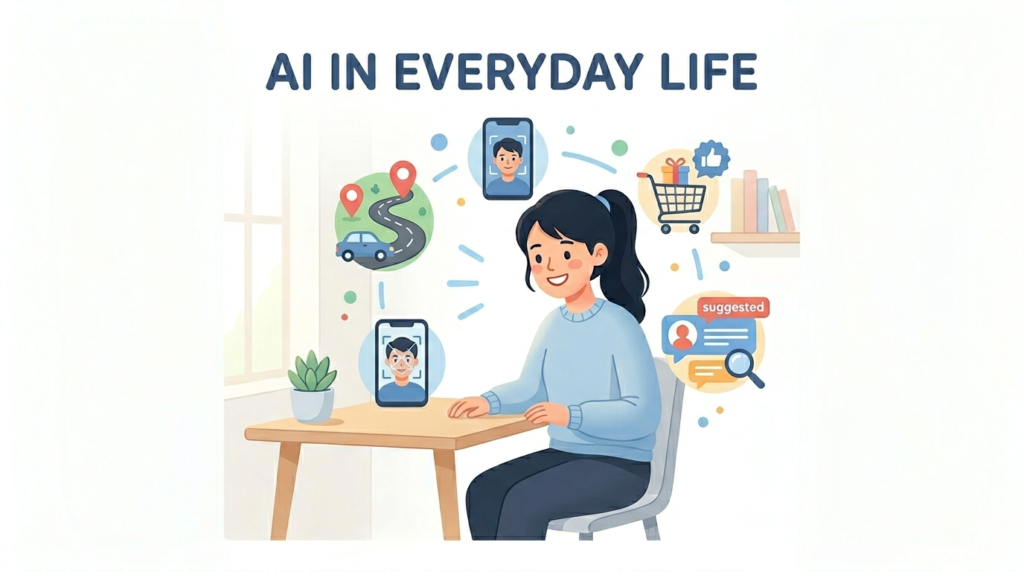
Many people think AI belongs only to tech companies.
That is not true.
You interact with AI daily.
Here are some common examples.
Smartphones
Your phone uses AI for:
- Face unlock
- Camera filters
- Battery optimization
- Voice typing
Social Media
Platforms recommend:
- Videos
- Friends
- Ads
- Content you may like
Online Shopping
Shopping websites suggest products based on behavior.
For example:
If you search shoes today, tomorrow you may see shoe recommendations everywhere.
That is AI tracking patterns.
Navigation Apps
Maps calculate:
- Fastest routes
- Traffic conditions
- Estimated arrival times
Without AI, travel would feel far more confusing.
Artificial Intelligence and Education
Education is changing because of AI.
Students now use AI tools for:
- Homework help
- Writing assistance
- Research summaries
- Language learning
Some tools even explain difficult topics in simple words.
For example, writing assistants help students improve grammar, structure, and productivity during assignments. You can explore more here: https://aiwithsahil.com/ai-writing-assistant-for-assignments-2026/
However, AI should support learning — not replace thinking.
Students still need creativity, understanding, and problem-solving skills.
Can Artificial Intelligence Replace Humans?
This is one of the biggest questions people ask.
The short answer:
Not completely.
AI is great at repetitive tasks.
Humans are better at:
- Creativity
- Emotions
- Relationships
- Leadership
- Complex decision-making
For example:
AI may write a rough article.
But human storytelling, emotion, humor, and experience still matter.
The future is likely about humans and AI working together rather than competing.
Benefits of Artificial Intelligence
Artificial intelligence is becoming popular for a reason.
It helps people save time, improve productivity, and make smarter decisions. Whether you are a student, business owner, blogger, or casual smartphone user, AI can make everyday tasks easier.
Let’s look at the biggest benefits of AI in simple words.
1. Saves Time
One of the biggest advantages of AI is speed.
Tasks that normally take hours can sometimes be completed in minutes.
For example:
- Email apps automatically sort spam
- Google Maps instantly finds faster routes
- AI writing tools generate ideas quickly
- Shopping apps recommend products instantly
Imagine manually searching thousands of products online.
AI reduces this effort by predicting what you might like.
That is why technology today feels faster and more convenient.
2. Improves Productivity
AI helps people work smarter.
For example, bloggers, students, marketers, and business owners often use AI tools to organize ideas, improve writing, and automate repetitive work.
If you want to understand how artificial intelligence is changing SEO and content creation, you can read this detailed guide: https://aiwithsahil.com/ai-seo-guide-2026-bloggers/
Instead of replacing work completely, AI often helps people finish tasks faster.
A content writer may use AI for brainstorming.
A teacher may use AI to simplify lessons.
A business owner may automate customer support.
The result?
More productivity with less effort.
3. Better Accuracy
Humans make mistakes.
Machines do too, but AI systems can reduce human error in repetitive tasks.
For example:
In healthcare, AI can help identify patterns in medical scans.
In banking, AI detects unusual spending behavior to reduce fraud.
In navigation, apps predict traffic more accurately.
Accuracy improves because AI learns from huge amounts of data.
4. Personalized Experiences
Have you noticed how apps seem to know what you want?
That is personalization powered by AI.
Examples include:
- Netflix suggesting movies
- YouTube recommending videos
- Shopping apps showing related products
- Spotify creating playlists
AI studies behavior and improves recommendations over time.
This creates a smoother user experience.
5. Helps Businesses Grow
Companies love AI because it improves efficiency.
Businesses use AI for:
- Customer support chatbots
- Marketing automation
- Data analysis
- Product recommendations
For example, online stores often show “You may also like” suggestions.
This increases sales and improves customer satisfaction.
Before learning the benefits, remember that Artificial Intelligence Explained in Simple Words means understanding how machines help people make tasks faster and easier.
Risks and Disadvantages of Artificial Intelligence
AI is powerful, but it is not perfect.
Like every technology, artificial intelligence comes with challenges.
Understanding both benefits and risks gives a balanced perspective.
1. Job Automation Concerns
Many people worry about jobs.
Some repetitive jobs may change because of automation.
For example:
- Data entry
- Basic customer support
- Simple repetitive office tasks
However, history shows that technology also creates new opportunities.
When computers became common, many jobs changed instead of disappearing.
The same may happen with AI.
New roles related to technology, creativity, problem-solving, and AI management are growing quickly.
2. Privacy Issues
AI learns from data.
Sometimes this creates concerns around privacy.
For example:
Social media apps track interests.
Shopping platforms remember searches.
Recommendation systems study behavior.
This helps improve experiences, but many people ask an important question:
“How much information should companies collect?”
That debate continues worldwide.
3. Wrong Information or Bias
AI is not always correct.
Sometimes it produces inaccurate answers or biased outcomes.
Why?
Because AI learns from existing data.
If the training data contains mistakes or unfair patterns, AI may repeat them.
That is why human review still matters.
4. Overdependence on Technology
Another issue is relying too much on AI.
For example:
Students copying answers without learning.
Businesses depending completely on automation.
Writers publishing AI-generated content without checking facts.
AI works best as an assistant — not as a replacement for thinking.
Artificial Intelligence Examples in Real Life
To truly understand AI, let’s look at real-world examples you already use.
Virtual Assistants
Voice assistants answer questions, set alarms, or provide reminders.
You ask:
“What is the weather?”
AI understands and responds.
That feels simple, but many intelligent systems work behind the scenes.
Recommendation Systems
Streaming and shopping platforms recommend content based on behavior.
Examples include:
- Movies you may enjoy
- Products you may buy
- Videos similar to previous interests
This makes browsing easier.
Smart Cameras
Modern phones use AI in photography.
AI helps improve:
- Brightness
- Portrait effects
- Image quality
- Face detection
That is why smartphone pictures look surprisingly professional today.
Smart Homes
Smart devices now automate homes.
Examples:
- Smart lights
- Voice-controlled devices
- Smart temperature systems
Interestingly, AI is also helping homeowners redesign living spaces more efficiently through digital planning and automation tools. You can explore examples here: https://aiwithsahil.com/ai-interior-design-tools-small-homes/
Artificial Intelligence vs Human Intelligence
Many people compare AI with humans.
But they are very different.
Humans Are Better At:
- Creativity
- Emotional understanding
- Relationships
- Imagination
- Moral decision-making
Humans understand emotions, humor, culture, and feelings.
Machines struggle with these areas.
AI Is Better At:
- Fast calculations
- Data analysis
- Repetitive work
- Pattern recognition
For example:
A human doctor understands emotions and context.
AI can help analyze thousands of medical records quickly.
Together, they become more effective.
This is why experts believe the future is collaboration, not competition.
Is Artificial Intelligence Dangerous?
This question appears everywhere online.
The answer is:
It depends on how people use it.
AI itself is not “good” or “bad.”
It is a tool.
Think of a kitchen knife.
A knife helps cook food.
But it can also be dangerous if misused.
AI works similarly.
Positive uses include:
- Healthcare improvements
- Education support
- Productivity tools
- Better accessibility
Risks include:
- Fake content
- Privacy concerns
- Scams
- Misinformation
The real issue is responsible use.
Governments, researchers, and technology companies continue discussing rules and safety systems.
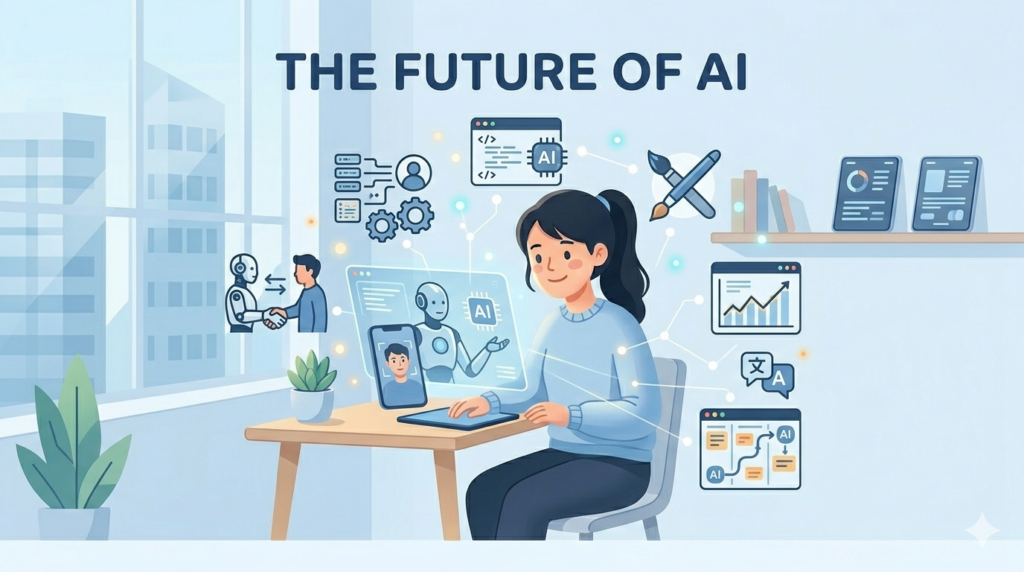
The Future of Artificial Intelligence
Artificial intelligence will likely become even more common.
Experts predict stronger AI integration in:
Healthcare
Doctors may use AI to detect diseases faster.
AI can already help identify patterns in scans and reports.
Education
Students may get personalized tutoring experiences.
Learning may become more interactive.
Transportation
Self-driving systems may improve road safety and reduce accidents.
Business
Automation will continue helping companies save time and reduce costs.
The future will likely include more human-AI teamwork rather than total replacement.
People who learn how to work with AI may have better opportunities in many industries.
How to Learn Artificial Intelligence as a Beginner
If you are new to AI, the good news is that learning artificial intelligence is easier than ever.
You do not need to become a programmer on day one.
Start small.
Focus on understanding how AI works in real life.
If you want to learn AI from trusted beginner-friendly sources, you can explore platforms like Google AI Learning Resources and IBM Guide to Artificial Intelligence to better understand real-world AI concepts.
Here are a few beginner-friendly steps:
Learn Basic AI Concepts
Start with simple topics like:
- What is artificial intelligence
- Machine learning basics
- AI in daily life
- Automation and smart systems
You do not need technical terms in the beginning.
Understanding the basics builds confidence.
Use AI Tools Yourself
The easiest way to understand AI is to use it.
Try:
- AI chat tools for asking questions
- Writing assistants for content ideas
- Translation tools
- Image-generation platforms
- Productivity apps
The more you experiment, the easier AI becomes to understand.
Stay Updated With AI Trends
Artificial intelligence changes quickly.
New tools, updates, and features appear regularly.
Reading blogs, watching tutorials, and following trusted educational platforms can help you stay informed.
Common Myths About Artificial Intelligence
Many people misunderstand AI because of movies and internet rumors.
Let’s clear up a few myths.
Myth 1: AI Will Take Every Job
Reality:
AI may automate some repetitive tasks, but many jobs will evolve instead of disappearing.
New opportunities are already appearing in technology, content, automation, business, and digital services.
People who learn to work with AI may benefit the most.
Myth 2: AI Thinks Like Humans
Reality:
AI does not think like a person.
It identifies patterns and predicts outcomes based on data.
It does not have emotions, opinions, or consciousness.
Myth 3: Artificial Intelligence Is Only for Tech Experts
Reality:
Not true.
Students, bloggers, teachers, marketers, shop owners, and creators all use AI today.
You do not need coding knowledge to benefit from many AI tools.
Myth 4: AI Is Always Correct
Reality:
AI can make mistakes.
It may sometimes provide outdated, incomplete, or incorrect information.
That is why fact-checking matters.
Experts recommend using AI as a helpful assistant rather than blindly trusting every answer.
Quick Summary: Artificial Intelligence Explained in Simple Words
If someone asks you:
“What is artificial intelligence?”
You can explain it like this:
Artificial intelligence is technology that helps machines learn from data, recognize patterns, and make smart decisions.
Simple examples include:
- YouTube recommendations
- Voice assistants
- Smartphone face unlock
- Online shopping suggestions
- Smart navigation apps
AI helps make everyday tasks easier, faster, and more personalized.
At the same time, it also brings challenges related to privacy, job automation, and misinformation.
The key is balance.
Using AI wisely can improve learning, productivity, and creativity.
Frequently Asked Questions (FAQs)
What is artificial intelligence in simple words?
Artificial intelligence is technology that allows machines to learn from information, recognize patterns, and make smart decisions without constant human instructions.
What are examples of AI in daily life?
Examples include:
- Google Maps navigation
- YouTube recommendations
- Face unlock on smartphones
- Shopping recommendations
- Voice assistants
Is artificial intelligence difficult to understand?
No.
AI becomes easier to understand when explained using real-life examples instead of technical language.
You use AI every day, even if you do not notice it.
Can AI replace humans?
Not completely.
AI is useful for repetitive tasks, but humans remain stronger in creativity, emotional understanding, leadership, and decision-making.
What is the future of artificial intelligence?
AI will likely become more common in healthcare, education, transportation, business, and everyday apps.
Most experts believe humans and AI will work together rather than compete.
Conclusion
Artificial intelligence may sound complicated at first, but when explained in simple words, it becomes much easier to understand.
You already use AI every day.
When your phone predicts words, streaming apps recommend videos, or maps suggest faster routes, artificial intelligence is quietly helping behind the scenes.
The biggest thing to remember is this:
AI is not magic, and it is not science fiction. It is simply technology designed to make tasks smarter, faster, and easier.
Like every powerful tool, artificial intelligence has benefits and challenges.
It can save time, improve productivity, personalize experiences, and support learning. At the same time, people must use it responsibly and think critically.
As technology grows, understanding AI will become an increasingly valuable skill.
Even if you are a beginner today, learning the basics of artificial intelligence can help you better understand the future of work, education, business, and everyday life.
In the end, Artificial Intelligence Explained in Simple Words is simply about understanding how smart technology supports daily life and improves convenience.