

Creating high-quality SEO content used to take hours of research, writing, editing, and optimization. But in 2026, AI tools have completely changed the game. Bloggers, affiliate marketers, businesses, and content creators are now using AI prompts to create SEO-friendly articles faster than ever.
The real secret is not just using AI — it’s using the right prompts.
A weak prompt gives generic content. A powerful prompt gives structured, engaging, Google-friendly articles that can actually rank.
In this guide, you’ll discover 7 powerful AI prompts to write SEO content in minutes, along with practical examples, expert tips, and real strategies that help content rank on Google Search and AI-generated overviews.
Whether you are a beginner blogger or an experienced marketer, these prompts can save hours of work while improving content quality.
If you want to improve your content strategy, you can also learn more about SEO basics from Google SEO Starter Guide.
Why AI Prompts Matter for SEO Content
Most people think AI writing tools automatically create perfect articles.
That’s not true.
AI is only as smart as the instructions you give it. A detailed prompt acts like a roadmap. It tells the AI:
- What to write
- Who the audience is
- Which keywords to include
- How the tone should sound
- How to structure the article
- What SEO elements to optimize
Without a strong prompt, the output often becomes repetitive, robotic, or poorly optimized
According to content marketing experts, properly guided AI-generated articles can dramatically improve workflow speed while maintaining search visibility when edited carefully.
That’s why professional bloggers now spend more time crafting prompts than writing manually.
If you want better AI-generated articles, learning how to create detailed prompts is extremely important. Many beginners make the mistake of using short instructions, which leads to weak content. You can learn the complete process in ChatGPT prompt kaise likhe guide.
What Makes an AI Prompt Powerful?
Before jumping into the prompts, let’s understand what separates an average prompt from a high-performing one.
A powerful AI writing prompt usually includes:
Clear Topic Instructions
The AI should know the exact topic and angle.
Example:
Instead of:
“Write about blogging.”
Use:
“Write a beginner-friendly SEO guide about starting a WordPress blog in 2026.”
Search Intent
Google ranks content based on intent.
Good prompts specify whether the article should:
- Inform
- Compare
- Sell
- Solve a problem
- Teach beginners
SEO Optimization Requirements
Include instructions like:
- Use H2 and H3 headings
- Add LSI keywords
- Optimize for featured snippets
- Write meta description
- Include FAQs
Human Tone
AI-generated content fails when it sounds robotic.
Strong prompts specify:
- Conversational tone
- Short paragraphs
- Storytelling
- Human examples
- Simple language
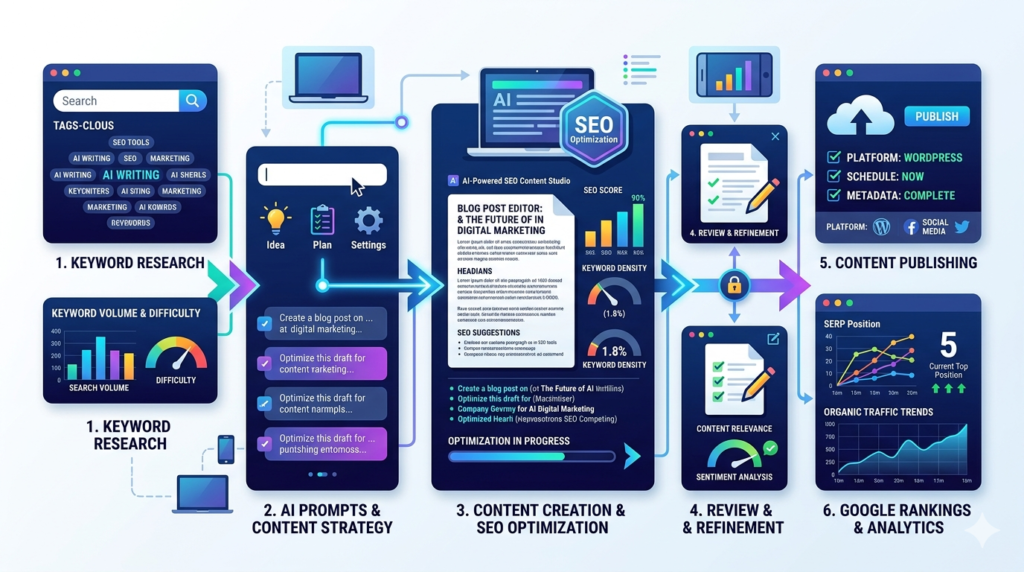
1. The Complete SEO Blog Post Prompt
This is one of the most effective prompts for creating long-form blog posts that are optimized for Google Search.
AI Prompt
Write a 2,500-word SEO-optimized blog post on [TOPIC].
Use a conversational and human tone.
Structure the article with H2, H3, and H4 headings.
Include the primary keyword naturally throughout the article.
Add LSI keywords, featured snippet optimization, FAQs, and actionable tips.
Make paragraphs short and easy to read.
Use storytelling, examples, statistics, and expert insights to improve EEAT signals.
Write an engaging introduction and conclusion.
Ensure the article is plagiarism-free and optimized for Google ranking.
Why This Prompt Works
This prompt combines:
- SEO structure
- Human readability
- EEAT optimization
- User engagement
- Search intent targeting
It creates content that feels natural while staying optimized for ranking.
2. The Featured Snippet Optimization Prompt
Featured snippets can dramatically increase click-through rates.
This prompt helps AI generate snippet-friendly sections.
AI Prompt
Write a clear answer to the question: [QUESTION].
Keep the answer between 40 and 60 words.
Use simple language and direct explanations.
After the short answer, expand with detailed examples and practical insights.
Format the content for Google featured snippets.
Example
If your keyword is:
“How to start a blog?”
The AI generates:
- A concise snippet answer
- Step-by-step explanation
- Optimized structure
This increases your chances of appearing in position zero on Google.
AI writing tools are creating new opportunities for freelancers, bloggers, and creators to generate income online without large investments. Many people are already using content writing and AI services as side hustles. You can explore more ideas in earn money online without investment guide.
3. The SEO Article Outline Prompt
Many bloggers struggle with article structure.
This prompt creates a professional outline in seconds.
AI Prompt
Create a detailed SEO-friendly blog post outline for the topic [TOPIC].
Include:
- H2 headings
- H3 subheadings
- FAQ section
- Search intent optimization
- Suggested keyword placement
- Reader pain points
- Actionable sections
The outline should be designed to rank on Google Search.
Why It’s Powerful
A good outline:
- Improves readability
- Keeps content organized
- Prevents keyword stuffing
- Helps AI produce better long-form articles
Professional SEO writers almost always start with an outline first.
4. The Humanizing AI Content Prompt
One major issue with AI-generated content is that it often sounds repetitive.
This prompt fixes that problem.
AI Prompt
Rewrite this article in a natural, human tone.
Avoid robotic phrases and repetitive wording.
Use conversational language, storytelling, and emotional connection.
Keep paragraphs short and engaging.
Make the content sound like it was written by an experienced human writer.
Why Humanization Matters
Google increasingly values:
- User experience
- Helpful content
- Original insights
- Reader engagement
If content feels machine-generated, readers leave quickly — which hurts rankings.
Humanized content improves:
- Time on page
- Trust
- Readability
- SEO performance
5. The EEAT Optimization Prompt
Google’s EEAT principles are now more important than ever.
EEAT stands for:
- Experience
- Expertise
- Authoritativeness
- Trustworthiness
This prompt helps AI create content aligned with those signals.
AI Prompt
Improve this article for Google EEAT principles.
Add expert insights, practical examples, trustworthy explanations, statistics, and real-world experiences.
Make the content authoritative yet easy to understand.
Ensure the article builds reader trust and demonstrates expertise.
Why This Prompt Helps Rankings
Google wants content written by people who understand the topic deeply.
Adding:
- Real examples
- Expert opinions
- Research-backed insights
- Personal experiences
can improve perceived quality significantly.
6. The SEO Meta Description Prompt
A great meta description can improve click-through rates from search results.
AI Prompt
Write 5 SEO-optimized meta descriptions for the keyword [KEYWORD].
Keep each meta description under 155 characters.
Make them engaging, clickable, and optimized for Google Search.
Include emotional triggers and action words.
Example Meta Description
“Discover 7 powerful AI prompts to write SEO content faster, rank higher on Google, and create human-like blog posts in minutes.”
This type of description:
- Improves CTR
- Attracts readers
- Matches search intent
7. The AI Overview Optimization Prompt
Google AI Overviews are changing SEO rapidly.
Content now needs to be:
- Direct
- Informative
- Structured
- Context-rich
This prompt helps optimize content for AI-generated search experiences.
AI Prompt
Write content optimized for Google AI Overviews.
Use concise explanations, structured headings, bullet points, definitions, and clear answers.
Focus on topical authority, semantic SEO, and user intent.
Make the content easy for AI systems to summarize and cite.
Why This Matters in 2026
AI-driven search experiences are growing fast.
Content that is:
- Well-structured
- Fact-based
- Easy to summarize
has a better chance of appearing in AI-generated results.
How Bloggers Are Using AI Prompts Successfully
Many successful bloggers now use a hybrid workflow.
Instead of letting AI fully write everything, they:
- Use AI for outlines
- Generate first drafts
- Add personal insights
- Optimize SEO manually
- Edit for readability
This approach saves time while maintaining quality.
For example, affiliate marketers often create:
- Product reviews
- Comparison articles
- How-to guides
- Pinterest content
- Email sequences
using advanced prompts as a starting point.
Many new bloggers are now using AI tools to speed up content creation and grow their websites faster. With the right SEO strategy and consistency, blogging can even become a real income source. If you are starting your journey, read this detailed guide on mahine me blogging se paise kaise kamaye
Common Mistakes When Using AI Prompts
Even powerful prompts can fail if used incorrectly.
Here are common mistakes to avoid.
Using Generic Instructions
Bad example:
“Write an article about SEO.”
Good example:
“Write a beginner-friendly 2,500-word SEO guide for WordPress bloggers.”
Specificity matters.
Ignoring Search Intent
If the keyword is informational, don’t create sales-heavy content.
Match the content to what users actually want.
Publishing Without Editing
AI-generated drafts still need:
- Fact checking
- Human insights
- Grammar review
- SEO adjustments
Never publish raw AI output directly.
Keyword Stuffing
Overusing keywords can hurt rankings.
Use:
- Natural keyword placement
- Semantic SEO
- LSI keywords
instead of repeating the same phrase endlessly.
Best AI Tools for SEO Content Writing
Several AI tools work well with advanced prompts.
Popular options include:
- OpenAI
- Google AI tools
- Anthropic
- Jasper
- Copy.ai
The real advantage comes from how you use prompts — not just which tool you choose.
If you are looking for beginner-friendly AI tools for writing, productivity, and learning, there are several free options available today. Students and beginners can also explore these best free AI tools for students in India to improve their workflow and content creation skills
SEO Tips to Make AI Content Rank Higher
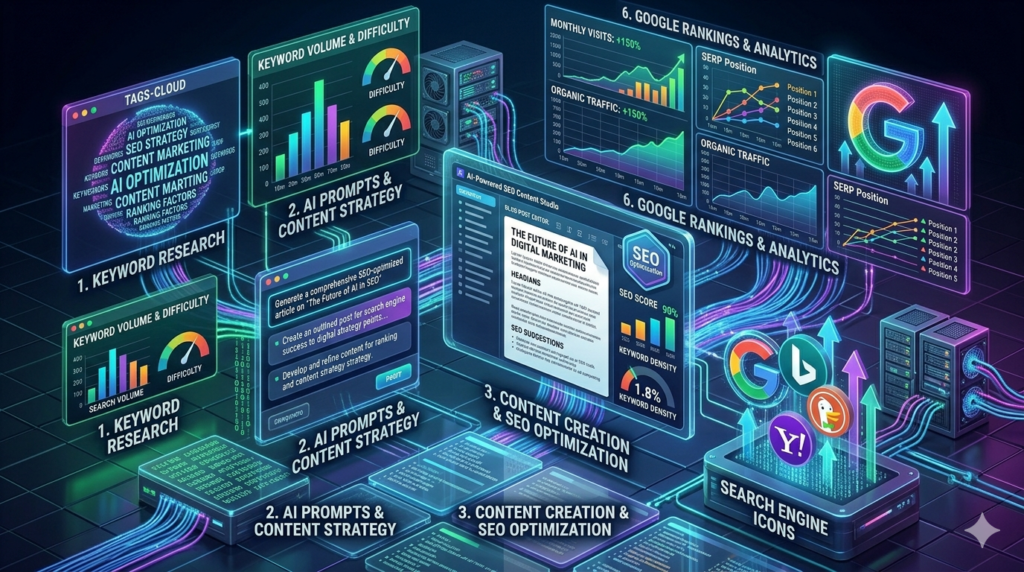
Here are proven optimization tips that improve AI-assisted content performance.
Focus on Topical Authority
Create multiple related articles around one niche.
Example:
If your niche is blogging, publish:
- SEO guides
- Pinterest marketing tips
- AI writing tutorials
- Affiliate marketing strategies
This builds authority.
Improve Internal Linking
Link related articles naturally.
Internal links help:
- Search engines crawl your site
- Readers stay longer
- Pages gain contextual relevance
Use Original Examples
Even small personal experiences can make content stand out.
Google values originality more than copied generic information.
Add FAQs
FAQ sections help target:
- Voice search
- Featured snippets
- Long-tail keywords
Example FAQs:
- Are AI prompts good for SEO?
- Can AI-generated content rank on Google?
- Which AI tool is best for blogging?
Optimize for Readability
Use:
- Short paragraphs
- Bullet points
- Simple language
- Clear headings
Good readability improves user engagement
The Future of AI and SEO Content
AI content creation is evolving rapidly.
But one thing remains true:
Google rewards helpful content.
AI tools are becoming assistants — not replacements for creativity.
The best-performing blogs combine:
- AI efficiency
- Human storytelling
- SEO strategy
- Real expertise
Writers who learn prompt engineering now will have a major advantage in the future of search
Frequently Asked Questions
Can AI-generated content rank on Google?
Yes, AI-generated content can rank well if it is helpful, original, optimized for SEO, and edited properly by humans.
Are AI prompts important for SEO writing?
Absolutely. The quality of the prompt directly affects content quality, structure, readability, and optimization.
What is the best AI prompt for blog writing?
The best prompts include:
- Clear instructions
- SEO requirements
- Human tone guidance
- Search intent
- EEAT optimization
Does Google penalize AI content?
Google does not automatically penalize AI content. However, low-quality or spammy content can lose rankings regardless of how it was created.
How do I make AI content sound human?
Use prompts that request:
- Conversational language
- Storytelling
- Emotional tone
- Real examples
- Short paragraphs
Then manually edit the final draft.
These AI prompts for SEO content are helping bloggers, marketers, and businesses create optimized articles in less time.
Conclusion
AI prompts are becoming one of the most valuable skills in modern SEO and blogging.
The difference between average AI content and high-ranking content often comes down to prompt quality.
By using these 7 powerful AI prompts, you can:
- Create articles faster
- Improve SEO performance
- Optimize for AI overviews
- Increase readability
- Save hours of writing time
The future of content creation belongs to creators who combine AI tools with human creativity and strategic SEO