
AI Jobs in India for Beginners 2026 me sabse tezi se badhne wale career opportunities me se ek hain. Artificial Intelligence ki demand lagatar badh rahi hai, jisse freshers aur students ke liye naye job opportunities create ho rahe hain.
As a result, demand for AI professionals is rising rapidly. The good news is that you don’t need a computer science degree from a top university to start a career in AI. Many beginners are entering the industry through online courses, certifications, self-learning, and hands-on projects.
If you’re wondering how to get an AI job in India as a beginner, what skills you need, how much salary you can expect, and which career path to follow in 2026, this guide covers everything in detail.
Before exploring career opportunities, it’s important to understand artificial intelligence explained in simple words so you can build a strong foundation
Why AI Jobs Are Growing Rapidly in India
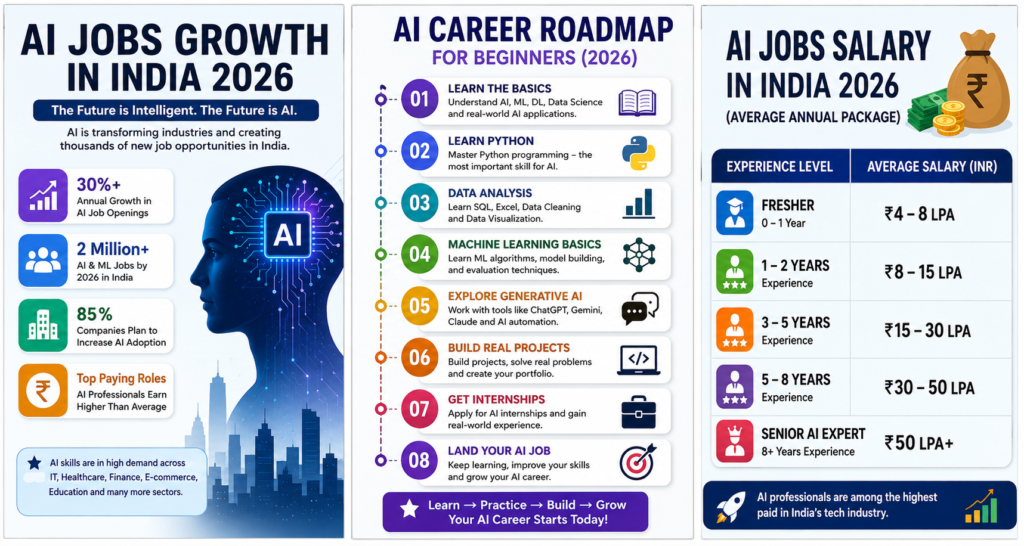
India has become one of the largest technology markets in the world. Businesses are investing heavily in Artificial Intelligence, Machine Learning, Automation, Data Analytics, and Generative AI tools.
Several factors are driving this growth:
- Increased adoption of AI-powered software
- Rising demand for automation across industries
- Growth of AI startups and SaaS companies
- Expansion of cloud computing platforms
- Popularity of ChatGPT, Gemini, Claude, and other AI models
- Government initiatives supporting AI innovation
According to multiple industry reports, AI-related hiring in India is expected to continue growing throughout 2026 and beyond. This creates significant opportunities for freshers and career switchers.
As a result, demand for AI Jobs in India for Beginners continues to rise across multiple industries.
What Are AI Jobs?
AI jobs involve developing, training, managing, or working with Artificial Intelligence systems.
These roles may include:
- Building machine learning models
- Training AI algorithms
- Working with data
- Creating AI-powered applications
- Developing chatbots
- Automating business processes
- Analyzing AI-generated insights
Not every AI role requires advanced mathematics or coding expertise. Many beginner-friendly positions are available today.
If you’re curious about practical applications, explore what work can be done with AI across different industries and business sectors.
Best AI Jobs in India for Beginners (2026)
The table below highlights some of the most popular entry-level AI careers.
| Job Role | Average Beginner Salary | Coding Required |
|---|---|---|
| AI Analyst | ₹4–8 LPA | Basic |
| Data Analyst | ₹4–9 LPA | Moderate |
| Machine Learning Intern | ₹3–6 LPA | Yes |
| AI Prompt Engineer | ₹5–12 LPA | Minimal |
| Junior Data Scientist | ₹6–12 LPA | Yes |
| AI Content Specialist | ₹4–10 LPA | No |
| AI Automation Specialist | ₹5–12 LPA | Low |
| Business Intelligence Analyst | ₹5–10 LPA | Moderate |
| AI Research Assistant | ₹4–8 LPA | Moderate |
| Generative AI Associate | ₹6–15 LPA | Basic |
The exact salary depends on location, company size, skills, portfolio quality, and practical experience.
Top AI Career Paths for Beginners
1. AI Prompt Engineer
Prompt Engineering became popular after the rise of Generative AI tools.
A Prompt Engineer designs effective prompts that help AI models generate better outputs.
Responsibilities
- Writing prompts for ChatGPT and Gemini
- Optimizing AI responses
- Testing AI workflows
- Creating AI-assisted content systems
- Improving productivity using AI tools
Skills Needed
- Strong communication skills
- Critical thinking
- Understanding AI tools
- Content creation knowledge
- Basic automation concepts
Salary Range
₹5–12 LPA
This is one of the easiest entry points into the AI industry.
2. Data Analyst
Data Analysts help businesses make decisions using data.
Responsibilities
- Collecting data
- Cleaning datasets
- Creating reports
- Building dashboards
- Identifying trends
Skills Needed
- Excel
- SQL
- Power BI
- Data visualization
- Statistics fundamentals
Salary Range
₹4–9 LPA
Many AI professionals begin their journey as Data Analysts.
3. Junior Machine Learning Engineer
Machine Learning Engineers develop systems that learn from data.
Responsibilities
- Building ML models
- Training datasets
- Testing algorithms
- Model optimization
- Performance monitoring
Skills Needed
- Python
- Machine Learning basics
- Statistics
- Data preprocessing
- Problem-solving
Salary Range
₹6–12 LPA
Although this role requires technical knowledge, beginners can enter through internships and projects.
4. AI Automation Specialist
Businesses increasingly automate repetitive tasks using AI.
Responsibilities
- Workflow automation
- AI integrations
- Process optimization
- No-code AI systems
- Automation design
Skills Needed
- Zapier
- Make.com
- AI tools
- Workflow mapping
- Basic logic building
Salary Range
₹5–12 LPA
This role offers strong growth opportunities even for non-technical candidates.
Skills Required for AI Jobs in India for Beginners
Many beginners assume AI requires advanced coding expertise. While coding helps, several AI roles focus more on practical problem-solving.
Technical Skills
- Python Programming
- SQL
- Data Analysis
- Machine Learning Fundamentals
- Statistics
- Data Visualization
- AI Tools Knowledge
- Cloud Platforms
Soft Skills
- Communication
- Analytical Thinking
- Problem Solving
- Creativity
- Adaptability
- Research Skills
Employers increasingly value practical project experience alongside technical skills.
If you’re still building your foundation, check out our detailed guide on AI skills for students in 2026 to understand which abilities employers are actively looking for.
Complete AI Career Roadmap for Beginners (2026)
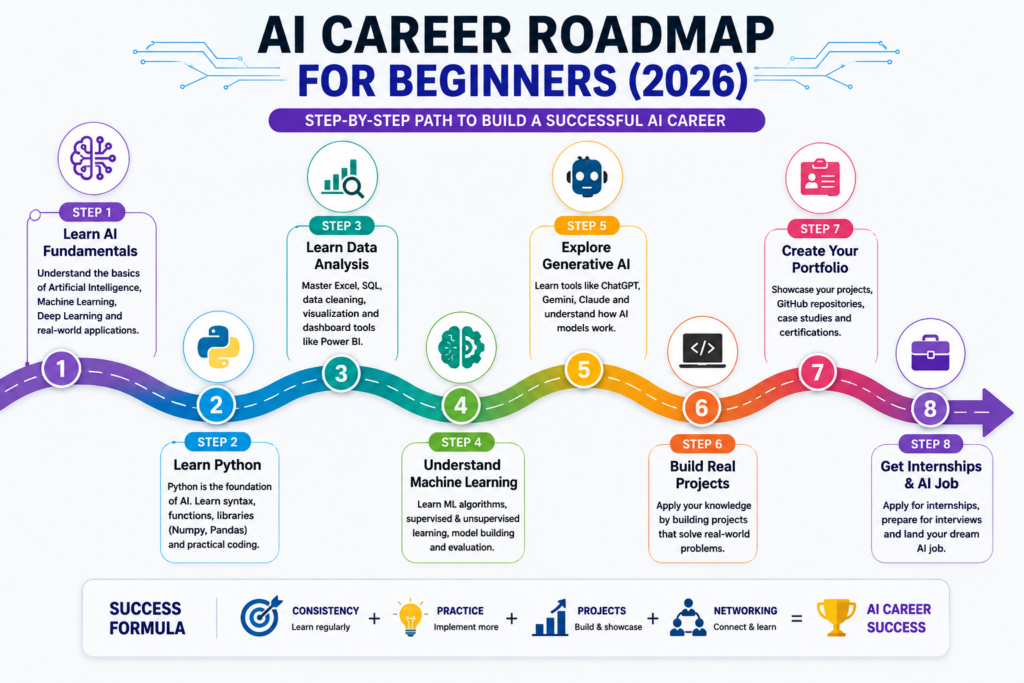
If you’re starting from zero, follow this step-by-step roadmap to build an AI career in India.
Step 1: Learn AI Fundamentals
Before diving into advanced topics, understand the basics:
- What is Artificial Intelligence?
- What is Machine Learning?
- What is Deep Learning?
- How Generative AI works
- Real-world AI applications
Focus on understanding concepts rather than memorizing definitions.
Step 2: Learn Python
Python is the most widely used programming language in AI.
Key topics:
- Variables and data types
- Loops and conditions
- Functions
- Lists and dictionaries
- File handling
- Basic object-oriented programming
You don’t need to become an expert immediately. A solid foundation is enough to start building projects.
Step 3: Learn Data Analysis
Data is the fuel of AI systems.
Learn:
- Excel
- SQL
- Data cleaning
- Data visualization
- Power BI or Tableau
These skills are valuable even if you don’t become a Machine Learning Engineer.
Step 4: Understand Machine Learning Basics
Important concepts include:
- Supervised Learning
- Unsupervised Learning
- Classification
- Regression
- Model Evaluation
- Feature Engineering
Focus on practical implementation rather than complex mathematics in the beginning.
Step 5: Explore Generative AI Tools
In 2026, Generative AI skills are becoming highly valuable.
Learn tools such as:
- ChatGPT
- Google Gemini
- Claude
- Perplexity
- Microsoft Copilot
Understand how businesses use these tools to improve productivity and automate tasks.
Step 6: Build Real Projects
Projects demonstrate your skills better than certificates.
Beginner project ideas:
- AI Resume Builder
- Chatbot using OpenAI APIs
- AI Content Generator
- Customer Support Assistant
- AI-Powered Research Tool
- Data Analytics Dashboard
Even small projects can significantly improve your chances of getting hired.
Step 7: Create a Portfolio
Your portfolio should showcase:
- Projects
- GitHub repositories
- Certifications
- Case studies
- Problem-solving abilities
Recruiters often evaluate portfolios before scheduling interviews.
Step 8: Apply for Internships
Internships help you gain real-world experience.
Look for:
- AI Intern roles
- Data Analyst internships
- Machine Learning internships
- AI Research internships
- Automation Specialist internships
Practical experience can often outweigh academic qualifications.
Best AI Courses and Certifications for Beginners
The right course can accelerate your learning journey.
| Course Type | Best For |
|---|---|
| Google AI Courses | Beginners |
| Microsoft AI Certifications | Career-focused learners |
| IBM AI Certifications | Practical AI skills |
| Machine Learning Courses | Technical roles |
| Data Analytics Certifications | Analyst positions |
| Generative AI Certifications | Prompt Engineering and AI automation |
When choosing a course, prioritize practical projects over theory-heavy content.
Beginners who want a structured learning path can explore the Machine Learning Crash Course from Google to understand core AI and machine learning concepts before moving to advanced topics.
Real Case Study: From Beginner to AI Professional
Let’s look at a realistic example.
Background
Rahul, a commerce graduate from India, had no coding experience.
What He Did
Month 1–2:
- Learned AI fundamentals
- Studied Python basics
Month 3–4:
- Learned SQL and Data Analytics
- Built dashboard projects
Month 5–6:
- Learned Generative AI tools
- Created automation workflows
Month 7–8:
- Built AI portfolio projects
- Applied for internships
Month 9:
- Secured an AI Analyst role
Outcome
Starting Salary: ₹6.5 LPA
This example demonstrates that consistent learning and project-building can help beginners enter the AI industry.
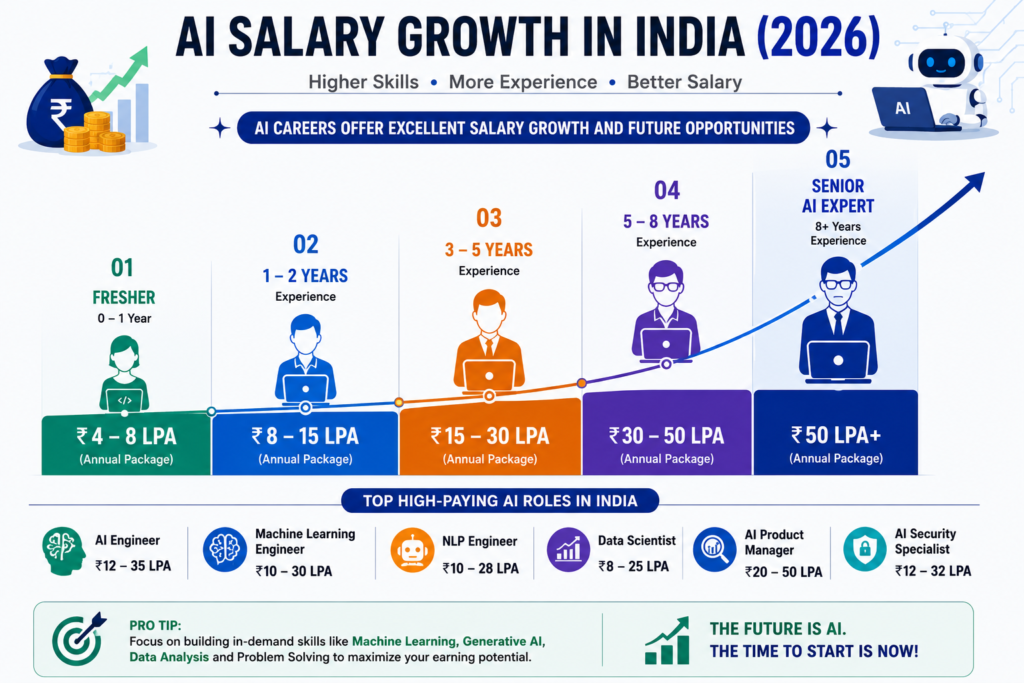
AI Salary Growth in India (2026)
Salary expectations for AI Jobs in India for Beginners company aur skills ke hisab se alag ho sakti hain.
One of the biggest attractions of AI careers is salary growth.
| Experience Level | Average Salary |
|---|---|
| Fresher | ₹4–8 LPA |
| 1–2 Years | ₹8–15 LPA |
| 3–5 Years | ₹15–30 LPA |
| 5–8 Years | ₹30–50 LPA |
| Senior AI Expert | ₹50 LPA+ |
Professionals specializing in Generative AI and Machine Learning often command higher salaries.
Top Companies Hiring AI Beginners in India
Many organizations actively recruit AI talent.
Technology Companies
- Microsoft
- Amazon
- Infosys
- TCS
- Wipro
- HCL Technologies
- Accenture
AI Startups
- Generative AI startups
- SaaS companies
- Automation platforms
- Data analytics firms
Startups often provide faster learning opportunities and broader responsibilities.
Common Mistakes Beginners Should Avoid
Learning Without Building Projects
Many people complete multiple courses but never create practical projects.
Employers value proof of skills more than certificates.
Waiting to Become Perfect
You don’t need to know everything before applying for jobs.
Start applying once you have:
- Basic skills
- 2–3 projects
- A portfolio
Ignoring Soft Skills
Communication and problem-solving abilities are essential in AI roles.
Technical knowledge alone is rarely enough.
Following Too Many Courses
Focus on implementation instead of collecting certificates.
A few high-quality projects are more valuable than dozens of unfinished courses.
How to Get Your First AI Job Faster
Follow these practical strategies:
- Build 3–5 AI projects.
- Create a strong LinkedIn profile.
- Publish project case studies.
- Participate in AI communities.
- Contribute to open-source projects.
- Apply consistently.
- Network with professionals.
- Prepare for technical interviews.
Consistency often matters more than talent during the early stages of an AI career.
Future of AI Jobs in India
The AI industry is expected to expand significantly over the next decade.
Growing areas include:
- Generative AI
- AI Automation
- Machine Learning
- Robotics
- Natural Language Processing (NLP)
- AI Security
- Data Science
- AI Product Management
Professionals who continuously update their skills will have the strongest career opportunities.
The growing demand for AI professionals is closely connected to emerging technologies and the latest AI blogging trends shaping the digital industry
Frequently Asked Questions (FAQs)
1. Can beginners get AI jobs without experience?
Yes. Many entry-level roles, internships, and trainee positions are designed for beginners. Projects and practical skills often matter more than prior job experience.
2. Is coding mandatory for AI jobs?
Not always. Roles such as Prompt Engineer, AI Content Specialist, and AI Automation Specialist may require little or no coding.
3. Which programming language is best for AI?
Python is the most widely used programming language for Artificial Intelligence and Machine Learning.
4. What is the average AI fresher salary in India?
Most beginners earn between ₹4–8 LPA, depending on skills, location, and company.
5. Can non-engineering students enter AI?
Absolutely. Students from commerce, arts, science, and management backgrounds are successfully entering AI-related careers.
6. How long does it take to learn AI?
A focused learner can develop job-ready skills within 6–12 months through consistent practice and project work.
7. Are AI certifications worth it?
Certifications can help, but projects and practical experience have a greater impact on employability.
8. Which AI job is easiest for beginners?
Prompt Engineering, AI Content Creation, Data Analytics, and AI Automation are among the most beginner-friendly options.
9. Is AI a good career in India in 2026?
Yes. AI remains one of the fastest-growing and highest-paying technology sectors in India.
10. What should I learn first for AI?
Start with AI fundamentals, then learn Python, Data Analysis, Machine Learning basics, and Generative AI tools.
Conclusion
Agar aap AI Jobs in India for Beginners explore karna chahte hain, to ab shuruaat karne ka sahi samay hai.
Artificial Intelligence is transforming industries and creating exciting career opportunities across India. Whether you’re a student, fresher, career switcher, or working professional, 2026 is an excellent time to enter the AI field.
The key is to focus on practical skills, real-world projects, and continuous learning. Start with AI fundamentals, develop relevant technical skills, build a portfolio, and gain hands-on experience through projects and internships.
Remember, employers are increasingly looking for people who can solve problems and demonstrate their abilities rather than simply holding certificates. By following the roadmap outlined in this guide, you can position yourself for a successful and rewarding AI career in India.
The sooner you start learning and building, the sooner you’ll be ready to take advantage of the growing demand for AI professionals.